AI Content Disclosure and the EU AI Act: What WordPress Site Owners Need to Know
Does every AI-assisted WordPress article need a label? Learn what Article 50 of the EU AI Act actually requires, when disclosure matters and how to make AI use transparent on your site.
d9
Published
AI-assisted content is now part of everyday publishing. Blog posts are drafted with ChatGPT, product descriptions are rewritten with AI, translations are generated in seconds and images can be created without ever opening a camera.
At the same time, the EU AI Act has introduced new transparency rules for certain AI-generated and manipulated content. Article 50 has applied since 2 August 2026, which raises an obvious question for WordPress site owners:
The short answer — no, the EU AI Act does not require every AI-assisted WordPress article to carry an AI label. But certain AI-generated or manipulated content is subject to specific transparency obligations, and voluntary disclosure can make sense well beyond the legal minimum.
What changed on 2 August 2026?
The EU AI Act was introduced as a broad regulatory framework for artificial intelligence in the European Union. Different parts of the regulation became applicable at different times.
The transparency obligations in Article 50 became applicable on 2 August 2026. They cover several situations where people should be able to recognise that they are interacting with AI or are being exposed to artificially generated or manipulated content.
The rules distinguish between providers of AI systems and deployers who use those systems. For a WordPress publisher, the most relevant parts are usually the obligations around AI-generated public-interest text and deepfake content.
Does every AI-generated blog post need a label?
No. This is one of the most important distinctions to understand.
Article 50 does not create a blanket rule saying that every sentence written with ChatGPT, Gemini, Claude or another AI tool must be visibly labelled.
For text, the rule specifically addresses AI-generated or manipulated material that is published for the purpose of informing the public about matters of public interest.
That can include areas such as politics, democratic processes, public administration, justice, fundamental rights, public safety and public health.
Important — an ordinary AI-assisted product description, tutorial or company blog post is not automatically covered by the public-interest text disclosure rule simply because an AI tool helped write it.
Human review makes an important difference
Article 50 also contains an important exception for AI-generated public-interest text.
The disclosure obligation does not apply under this provision where the AI-generated content has undergone human review or editorial control and a natural or legal person holds editorial responsibility for its publication.
That distinction matters for normal editorial workflows.
There is a meaningful difference between automatically generating hundreds of articles and publishing them untouched, and using AI to help create a draft that is then fact-checked, edited, rewritten and approved by a human editor who takes responsibility for the final publication.
Practical takeaway — using AI during research, outlining or drafting does not automatically mean that your finished article requires an AI disclosure under Article 50.
What about AI-generated images and deepfakes?
Images, video and audio are another important part of Article 50.
Deployers of AI systems that generate or manipulate image, audio or video content constituting a deepfake must disclose that the content has been artificially generated or manipulated.
There are special provisions for evidently artistic, creative, satirical, fictional or similar works. In those cases the disclosure can be provided in a way that does not unnecessarily interfere with the work itself.
This is also where publishers should distinguish between a clearly illustrative AI image and manipulated media that could reasonably appear to show a real person, event or situation that never actually happened.
Does this need an AI disclosure?
There is no universal answer because the exact context matters. But these examples show why not all AI use should be treated the same way.
| Example | Article 50 perspective |
|---|---|
| Blog article drafted with AI, then reviewed and edited by a human | Not automatically subject to the public-interest text disclosure rule. Human review and editorial responsibility are specifically relevant. |
| Fully AI-generated article about a matter of public interest, published without human editorial control | Disclosure may be required under Article 50(4). |
| AI-generated product description for an online shop | Not automatically covered by the public-interest text rule, although other laws, policies or transparency considerations may still apply. |
| AI-generated illustration used in a normal blog article | Not every AI image is automatically a deepfake. Context and whether the content falsely appears authentic matter. |
| Realistic manipulated image, video or audio showing a person doing or saying something they did not do | Deepfake transparency requirements can apply. |
These examples are simplified for general information and are not legal advice. The exact legal assessment depends on the content, context, role of the publisher and applicable law.
Legal requirement and good transparency are not the same thing
The legal minimum is only one reason to think about AI disclosure.
Even when a label is not legally required, telling readers how AI was used can still be a sensible editorial choice.
A short disclosure can explain that AI helped with research, translation, drafting or image creation while making clear that a human reviewed and approved the final result.
This can be particularly useful for publishers, agencies, companies and editorial teams that want a consistent policy instead of leaving every author to invent their own disclosure wording.
A useful principle — disclosure does not have to mean “AI wrote this.” It can accurately describe how AI contributed and where human editorial responsibility remained.
What can an AI disclosure look like?
A disclosure should be understandable. In most cases you do not need a paragraph full of legal language.
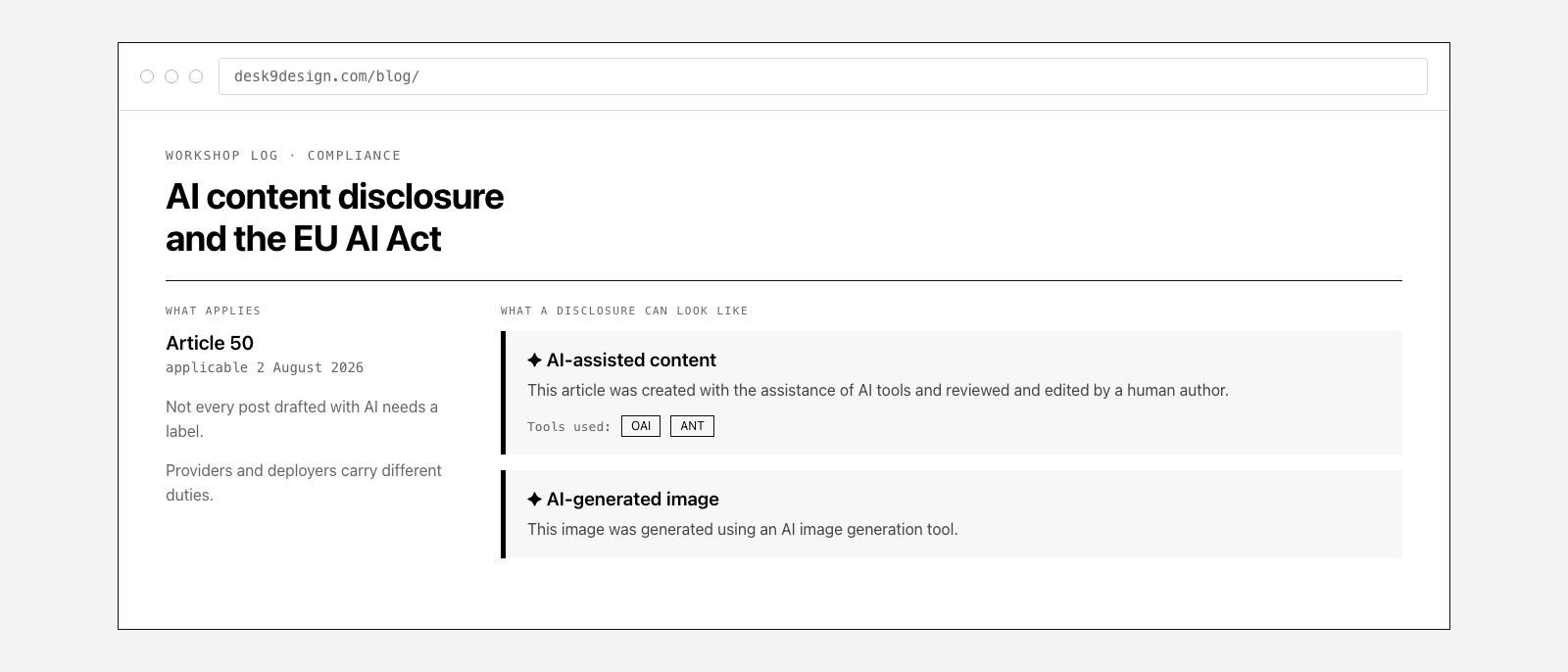
AI-assisted content
This article was created with the assistance of AI tools and reviewed and edited by a human author.
AI-assisted drafting
AI tools were used during research and drafting. The final content was reviewed, edited and approved by a human author.
AI-generated image
This image was generated using an AI image generation tool.
How to add AI disclosures in WordPress
For one article, adding a short paragraph manually is easy.
The workflow becomes more difficult when a site has dozens of authors, hundreds of posts, different AI tools, generated images and different levels of AI involvement.
That is exactly why I built Desk9 AI Content Disclosure.
The free WordPress plugin provides a consistent way to document AI-assisted work directly inside WordPress. You can choose the AI tools used, describe the level of AI involvement, add disclosures with a Gutenberg block or shortcode, automatically append notices to relevant posts and override the settings for individual articles.
Individual images can also be marked as AI-generated or AI-edited, including the tool used to create them. Everything is stored and rendered on your own WordPress site without adding a separate disclosure service, tracking endpoint or cookie.
What the plugin does not do
No WordPress plugin can automatically make a website compliant with the EU AI Act.
Whether a specific disclosure is legally required depends on your role, the type of AI system, the content you publish, the context in which it appears and potentially other applicable laws and regulations.
AI Content Disclosure is therefore a transparency tool, not a legal compliance certificate. It gives you the technical and editorial tools to make AI involvement visible when you decide or are required to disclose it.
Legal note — this article provides general information about AI transparency and WordPress publishing. It is not legal advice. If compliance is important to your organisation, have your specific use case reviewed by a qualified professional.
Frequently asked questions
Do I have to label every article written with ChatGPT?
No. Article 50 does not impose a general disclosure requirement on every AI-assisted article. The specific rule for text concerns AI-generated or manipulated text published to inform the public about matters of public interest, and it includes an exception involving human review or editorial control and editorial responsibility.
Should I disclose AI use even when it is not legally required?
That is an editorial decision. Many publishers may choose to disclose AI assistance voluntarily because it provides readers with useful context and creates a consistent transparency policy.
Does human editing remove every AI Act obligation?
No. The human-review exception discussed here relates specifically to the Article 50 rule for certain AI-generated or manipulated text. Other transparency obligations and other areas of law can still be relevant depending on the use case.
Can WordPress automatically add an AI disclosure?
Yes. Desk9 AI Content Disclosure can automatically append a disclosure to posts you mark as AI-relevant. You can also place the disclosure manually with a Gutenberg block or shortcode and change the wording or tools on individual posts.
Transparency without overcomplicating it
AI transparency does not need to turn every article into a legal document.
The useful starting point is much simpler: understand how AI contributed, decide whether disclosure is legally required or editorially useful, and explain that contribution clearly to your readers.
As AI becomes a normal part of publishing workflows, having a consistent way to document that process is likely to become more useful — not less.
Make AI use visible in WordPress.
Add clear disclosures to posts and images, record the tools used and keep everything on your own site.
Get AI Content Disclosure — Free →
Sources: Regulation (EU) 2024/1689, Article 50; European Commission Guidelines on transparency obligations for providers and deployers of AI systems, published July 2026.
d9
About the author
desk9 is a one-developer WordPress shop. Every article here documents something built, measured or broken first-hand — maintaining a small catalog of plugins and themes across thousands of live sites.